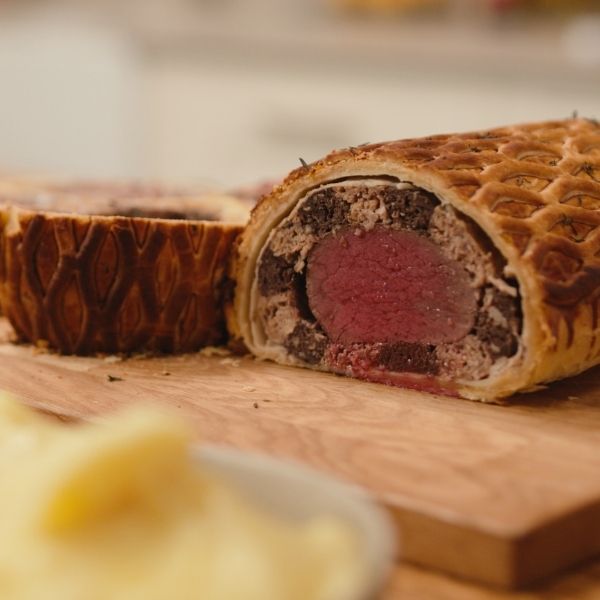
Adam Handling’s Beef, Haggis & Black Pudding Wellington
BeefMeat

Adam Handling’s Beef, Haggis & Black Pudding Wellington

Adam Handling's Beef, Haggis & Black Pudding Wellington as seen and heard on The Recipe podcast.

  • Prep Time: 60 mins
  • Cooking Time: 60 mins
  • 10 people
Used in this recipe Extra Virgin Olive Oil

Ingredients

Haggis Mousse

  • 250g haggis
  • 200g chicken breast
  • 2 egg yolks
  • Salt, to taste
  • Black pepper, to taste

Black Pudding Mousse

  • 170g black pudding
  • 200g chicken breasts
  • 3 egg yolks
  • Salt, to taste
  • Black pepper, to taste

Beef Fillet

  • 1 beef fillet
  • Dijon mustard
  • Salt and pepper

Pancakes

  • 85g plain flower
  • 130ml whole milk
  • 2 whole eggs
  • Salt, to taste

Method

For the Haggis Mousse

  1. Start by trimming up the chicken breast and removing any sinew or cartilage.
  2. Dice up the chicken into smaller pieces.
  3. Place into the food processor, along with half of the egg yolks, and blend into a smooth paste consistency.
  4. Once smooth, remove from the food processor and put into a separate tray/bowl.
  5. Dice the haggis into smaller pieces as well.
  6. Place into the food processor, along with the rest of the egg yolks, and blend until smooth.
  7. Remove from the food processor and mix the two together until fully incorporated and becomes 1 mixture.
  8. Season with the salt and pepper.
  9. Take a small amount of mix and turn it into a small patty.
  10. Cook this off and taste the mix.
  11. Once happy, put in piping bags.

For the Black Pudding Mousse

  1. Start by trimming up the chicken breast and removing any sinew or cartilage.
  2. Dice up the chicken into smaller pieces.
  3. Place into the food processor, along with half of the egg yolks, and blend into a smooth paste consistency.
  4. Once smooth, remove from the food processor and put into a separate tray/bowl.
  5. Dice the black pudding into smaller pieces as well.
  6. Place into the food processor, along with the rest of the egg yolks, and blend until smooth.
  7. Remove from the food processor and mix the two together until fully incorporated and becomes 1 mixture.
  8. Season with the salt and pepper.
  9. Take a small amount of mix and turn it into a small patty.
  10. Cook this off and taste the mix.
  11. Once happy, put in piping bags.

For the Beef Fillet

  1. Prepare the beef fillet by removing the tail end, the chain and the chateaubriand.
  2. Trim off all silver skin and sinew, so that you have a clean/ trimmed beef fillet that is equal thickness from end to end.
  3. Keep aside all trim and offcuts, as they can be used to make other dishes.
  4. Season the fillet with table salt.
  5. Using a large frying pan, evenly sear the outside of the fillet and then place into the fridge, to chill.
  6. Once chilled, brush the outside of the fillet in Dijon mustard.
  7. Once evenly coated, tightly roll the fillet in cling film and leave overnight in the fridge, to form an even cylindrical shape.
  8. For the pancakes
  9. Prep, sear and roll the beef fillet.
  10. Set up a large chopping board on a flat even workspace. Lay your cling film onto the board, followed by 4 pancakes laid out 2x2, making sure they are slightly overlapping with no gaps.
  11. Pipe your haggis mousse onto the pancakes. Pipe the mousse 1x1, horizontally, approximately 2cm thick. Starting with haggis, then black pudding, then haggis, then black pudding... continue this until all the pancake has been covered (ensure that the mousse you start with is the opposite to what you finish with e.g. start with haggis at the bottom, finish with black pudding at the top).
  12. Horizontally place the fillet in the centre in the middle of the pancakes. Pick up the end of the pancake closest to you and gently wrap around the fillet. Keep rolling it over, so the fillet is fully wrapped in the mousse and the beginning line of mousse joins onto the end line of mousse. Roll tightly in cling film and leave in the fridge overnight.
  13. Lay a sheet of puff pastry onto the bench. Brush the entire sheet of pastry evenly with egg wash.
  14. Remove the Wellington from the cling film and place onto the sheet of pastry (about 1⁄4 of the way up). Pick up the end of the pastry closest to you and wrap around the Wellington, ensuring there are no air pockets. Continue to roll it over so that the end slightly overlaps.
  15. Trim the excess pastry and fold in the 2 sides. Roll tightly in cling film and leave in the fridge overnight.
  16. Lattice the Wellington, using a lattice cutter.
  17. Place the finished Wellington onto an oven tray on baking parchment (just big enough for the Wellington to sit on (excess parchment will blow up the sides of the pastry and create an uneven cook/colour).
  18. Give the pastry one final egg wash, ensuring to cover all the pastry evenly.
  19. Place into the oven pre-heated at 210°C. Cook for 10 minutes at 210°C. Reduce down to 180°C and insert the probe. Set the probe temperature to 30°C.
  20. Once the centre of the fillet has reached 30°C, remove from the oven and trim off both ends of the pastry, to allow steam to escape.
  21. Put onto a cooling rack and allow to rest.